Wednesday, 31 August 2011

KVPY Solution to 1st Math problem

A=(0 i                                                                       I=( 1  0
      i 0)                      -----------1                                    0  1)
To find: I+A-A^2+.......+A^2010
so, first let us find A^2:
A^2 = A*A
        =( 0  i    *     (0  i
            i  0)           i  0)
       =  (-1  0
             0  -1)  --------------------------------2
(since i^2 = -1)

A^3 = A^2 * A
        = (-1  0     *     ( 0  i
             0  -1)            i  0)
       = (0  -i
           -i  0)  -----------------------------------3

A^4 = A^3  *  A
       =  (0  -i         *    (0  i
            -i  0)                i  0)
       =(1  0
           0  1)  ------------------------------------4
(since, -i*i = -(i^2) = -(-1) =1.)

Therefore, adding 1 2 3 and 4, we get 0 (ie, [0  0
                                                                    0  0])

so, in the given question, I+A-A^2+........+A^2010
becomes, I+A^2009+A^2010 because, all other terms are zero.
so, the answer is :
                              =  ( 1  0          +         (0  i          +   (-1  0
                                    0  1)                      i  0)                0  -1)
                             =(0  i
                                i  0)
which is the third option.
NOTE:
1>  A^2009 = (A^2008)*A
                   = (A^4)^504*A
                    =(1  0         * (0  i
                        0  1)           i  0)
                   =( 0  i
                       i  0)                                         (since, A^4 is an identity matrix)


2>Similarly, A^2010 = (-1  0
                                      0 -1)

3> According, to the series, A^2010 should have got - sign, but, in the question its given +.


Hope, my logic is correct.The answer may or may not be right. Verify the logic on your own.

KVPY Question Paper 2010 for stream SX/SB

Hi Guys,
Here is the link to download KVPY 2010 question paper for stream SX/SB.
http://aryanclasses.com/kvpy/kvpy-2010/KVPY-2010/KVPY-2010/kvpy2010-SB-SX.pdf
and for the answer key:
http://aryanclasses.com/kvpy/kvpy-2010/KVPY-2010/KVPY-2010/answerkey2010-SA-SB-SX.pdf

Monday, 29 August 2011

Calculus...

Why is the derivative of sin(x) is cos(x) and not something else...?
Here, is the proof for it:
First, use this identity:
sin (x + h) - sin x =
How this came ?
Here is the proof for it:

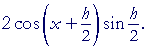
sin (x + h) − sin x=2 cos ½(x + h + x) sin ½(x + h − x)
=2 cos ½(2x + h) sin ½h
=


(If you are still not able to get it, Please go thorough some trignometric formulae...)


Proof.   It is not possible to prove that by applying the usual theorems on limits.  We have to go to geometry, and to the meanings of sin θ and radian measure.

Draw angle B'OA equal to angle θ, thus making arc AB' equal to arcBA;
draw the straight line BB', cutting AO at P;
and draw the straight lines BC, B'C tangent to the circle.
Then
BB' < arc BAB' < BC + CB'.
so that BB' = 2 sin θ;
  and BC = CB' = tan θ.  (For, tan θ = BC
OB
 = BC
 1 
 = BC.)
The continued inequality , therefore becomes:
2 sin θ < 2θ < 2 tan θ.
On dividing each term by 2 sin θ:
1 <    θ    
sin θ
 <    1   
cos θ
  And on taking reciprocal,
.
1 > sin θ
   θ
 > cos θ
On changing the signs, the sense changes again :
−1 < − sin θ
   θ
 < −cos θ,
and if we add 1 to each term:
0 < 1 − sin θ
   θ
 < 1 − cos θ.
Now, as θ becomes very close to 0 (θ 0),  cos θ becomes very close to 1; therefore,  1 − cos θ  becomes very close to 0.  The expression in the middle, being less than 1 − cos θ, becomes even closer to 0 (and on the left is bounded by 0), therefore the expression in the middle will definitely approach 0.  This means:
Which is what we wanted to prove.
The derivative of sin x
 d 
dx
sin x =  cos x
To prove that, we will apply the definition of the derivative .  First, we will calculate the difference quotient.
sin (x + h) − sin x
              h
=
=, on dividing numerator
 and denominator by 2,
=
We will now take the limit as h 0.  But the limit of a product is equal to the product of the limits.   And the factor on the right has the form sin θ/θ.  Therefore, according to the above proved theorem,  its limit is 1. Therefore,
 d 
dx
sin x =  cos x.
Hence, the derivative of sin x = cos x.